

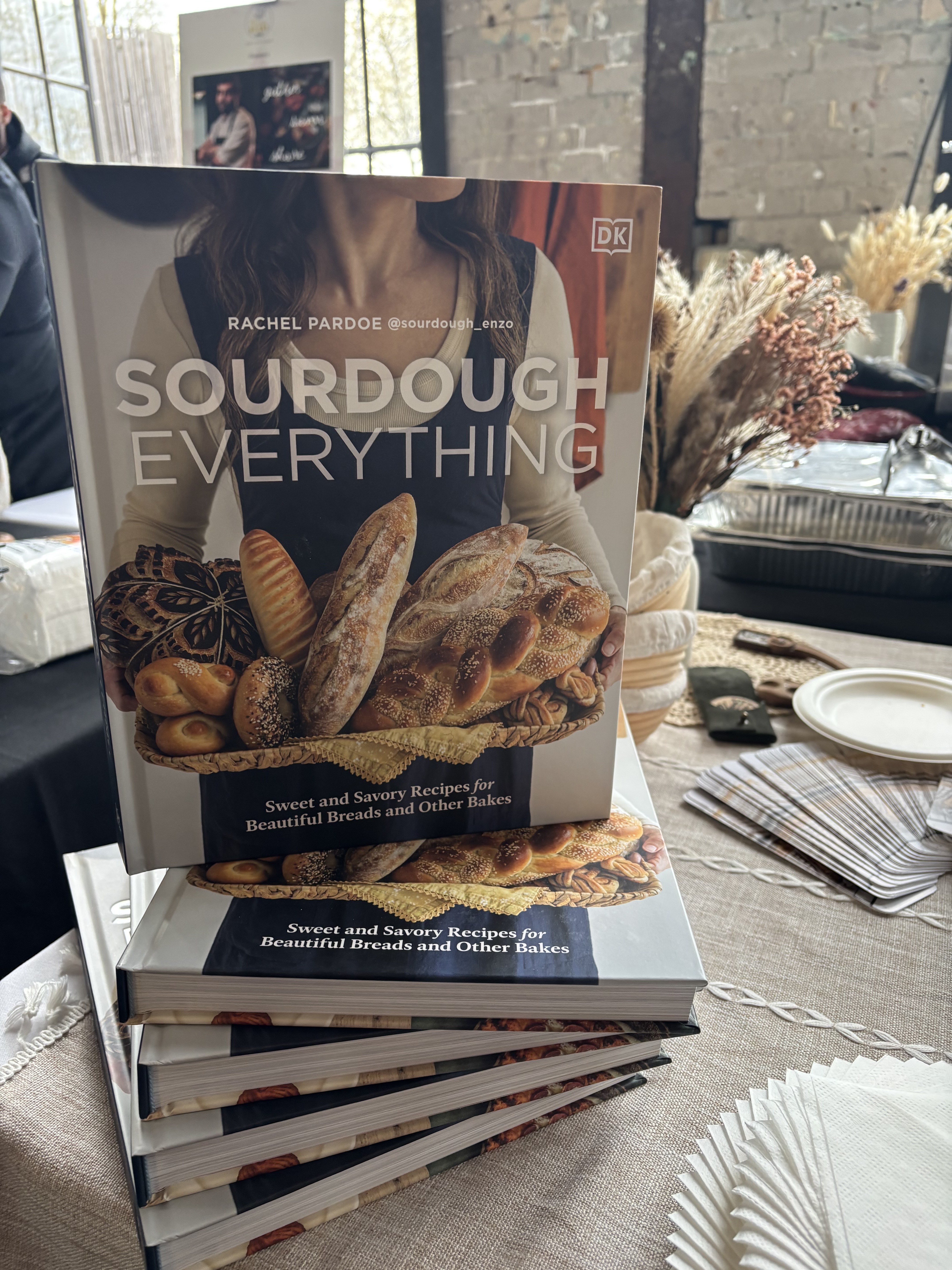
If sourdough envy is possible, I caught it while perusing Rachel Pardoe’s (aka Sourdough Enzo) Instagram. As if I needed another excuse to finally make and name a sourdough starter, Rachel’s beautifully scored sourdough loaves, sourdough carrot cake, and sourdough crepe recipes and those within the pages of her cookbook Sourdough Everything are about all I need.
I had the opportunity to chat with Rachel about her decision to write Sourdough Everything and the journey that led her to transforming sourdough into a practice that transcends trends.
*This conversation has been edited for clarity and length*
Q: In three words, how would you describe your style and philosophy as a creator?
A: Creative, authentic, approachable.
Q: How do you navigate writing recipes that are accessible to home cooks (e.g., time and money constraints, varied skill levels)
A: As someone who bakes out of my own home, and as someone who started with very little knowledge in the field, it is easy for me to create recipes, understanding and reflecting on where I first started out. For the proofing of sourdough, where most people struggle, I want to ensure my readers have a solid understanding of visual cues and what to look out for when preparing dough. I also ensured that each recipe indicated the active prep time, total time, and bake time, so that readers could easily plan their schedules.
Q: In your view, what drove the sourdough craze during the pandemic and what are some tips to help transition the fad into a staple bake for home cooks?
A: Sourdough requires time and patience. When the world shut down, people had so much time. Going to the store for a loaf of bread was no longer the easy nor safe thing to do. Making your own bread became a practical solution. Sourdough also really helped to foster a community in a time when people could no longer socialize in person. Seeing the successes of other bakers was something the community celebrated. And it was a great motivation to do the same.
Q: How do you know when a recipe you’re developing is ready for print?
A: When, after multiple trials, it has been successful in both texture and flavour, and can also produce consistent results. If I can make it more than once and get the same result, I know someone else will be able to do the same. When looking at the written recipe itself, it’s necessary to get at least a second set of eyes just to ensure there is no confusion as to the process.
Q: What is the average length of time one of your recipes goes from ideation to print?
A: It depends on the recipe! Some recipes have taken me just a week, whereas others have taken as long as several months. On average a few weeks.
Q: Was there a story or recipe you hesitated on but ultimately opted to include in your cookbook? What made you change your mind?
A: My sourdough croissant recipe. I had struggled with croissants for many, many months. I finally opted to include it after refining the lamination process, and ensuring I used European butter!
Q: With so many recipes available online today, why should home cooks and cooking enthusiasts still purchase physical cookbooks?
A: Online recipes really vary in quality, whereas cookbooks that have been traditionally published have recipes that are tested multiple times and in different environments. It’s a proven level of consistency that online recipes just don’t have. A cookbook also allows for personalization that an online recipe doesn’t. You can add notes to the pages of a recipe and make it your own.
Q: What motivated you to publish a cookbook and at that specific point in your career?
A: It is something I had been considering for some time, but was never able to dedicate the time required to do so. When DK approached me to write a cookbook, I was already dropping down to a casual position as a Care Coordinator. I knew this was the opportunity of a lifetime and it aligned perfectly with having more free time to dedicate to my business.
Q: Who is your greatest culinary inspiration?
A: Caroline Schiff. She’s a pastry chef who has written a number of books, including The Sweet Side of Sourdough. Her flavours and techniques are incredible and she has always been such a huge inspiration for me.
Q: What strategies do you recommend for managing creative blocks?
A: Reset and do something familiar. Sometimes the familiarity of a routine can help to break the shackles of a creative block. Sometimes a creative block stems from self-doubt, so immersing yourself in something that you know can be enough to kickstart your motivation. Doing something with which you are familiar can also allow your mind to drift. While your hands are occupied with muscle-memory tasks, your subconscious can help to solve the creative block.
Q: What is one piece of advice you’d like to offer to aspiring recipe developers?
A: Don’t be afraid to try something new and make mistakes. It’s all part of the joyous process of sourdough.
Q: Is there a new project you’re working on that you’d like to tease?
A: You might see me on TV in the near future, so keep an eye out!
Whether you are looking to start your sourdough journey or surprise guests (or even yourself!) with the versatility of your starter, get your hands on a copy of Sourdough Everything which you can find at Indigo and on other major bookshelves across Canada. Once you start following Rachel on Instagram, TikTok, and YouTube, you’ll be dreaming of sourdough.